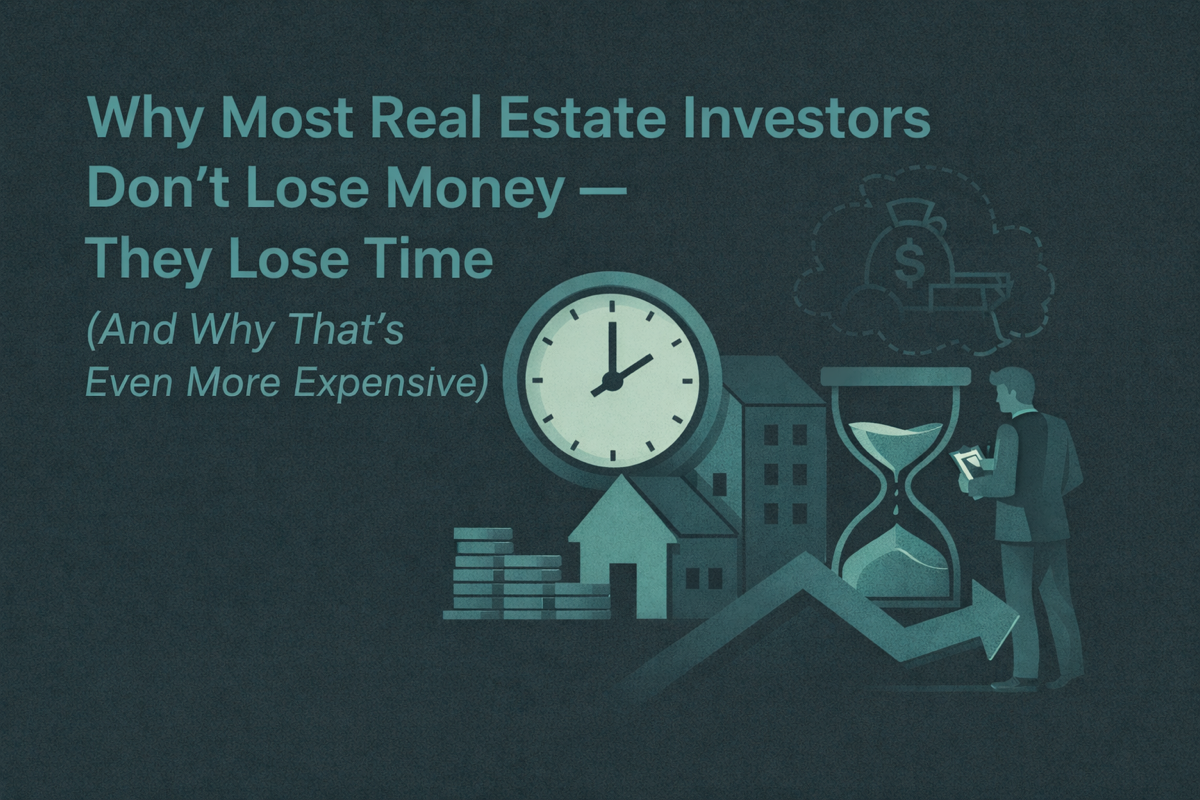
Why Most Real Estate Investors Don't Lose Money — They Lose Time (And Why That's Even More Expensive)
Introduction
Most real estate investors believe their biggest risk is losing money. In reality, that fear is often misplaced. The more dangerous, less visible threat is time — specifically, the slow, inefficient use of it.
Investors rarely look back and say, "That deal ruined me financially." What they say instead is, "I should have moved sooner," or "I spent months analyzing something I never bought," or "By the time I was confident, the opportunity was gone."
In real estate, capital is important. But decision velocity is what determines outcomes. The investors who outperform over a decade are not necessarily smarter or luckier — they are faster at reaching high-quality decisions.
This article explores why time, not money, is the most expensive currency in real estate investing — and how disciplined investors structure their process to stop bleeding it.
The Real Cost of Waiting Isn't What You Think
When investors hesitate, they usually believe they're being prudent. More analysis feels responsible. More validation feels safe. But in practice, excessive caution often produces the opposite result.
Every month spent evaluating the same deal is a month your capital sits idle. Idle capital doesn't just earn nothing — it misses compounding. Over a multi-year horizon, this opportunity cost dwarfs small underwriting errors.
A property purchased six months earlier doesn't just produce six more months of cash flow. It benefits from earlier rent increases, earlier principal reduction, and earlier appreciation exposure. Over five to ten years, those "lost months" quietly erase a meaningful percentage of total return.
Time delays don't show up in spreadsheets, but they show up clearly in net worth.
Analysis Paralysis Is a Portfolio Drag
One of the most common patterns among underperforming investors is analysis paralysis. Deals are reviewed repeatedly, assumptions are endlessly tweaked, and yet no decision is made. Ironically, the goal of avoiding mistakes leads to a different kind of failure — inaction.
The problem isn't diligence. The problem is unstructured diligence. Without a consistent framework, investors chase certainty instead of clarity. And certainty is impossible in real estate.
Experienced investors accept uncertainty early. They don't aim to eliminate risk; they aim to bound it. Once a deal meets defined criteria — returns, downside protection, risk tolerance — they move. They don't seek perfect information, only sufficient information.
This is where tools like Serava's Risk Score Calculator change the dynamic. By standardizing analysis, investors spend less time debating inputs and more time making decisions.
Speed Compounds Just Like Capital
The highest-performing portfolios share a common trait: velocity.
Velocity doesn't mean recklessness. It means being able to:
- Evaluate deals quickly
- Disqualify weak opportunities immediately
- Focus energy only on viable assets
- Deploy capital with confidence
When investors shorten their decision cycle from months to days, portfolio growth accelerates. More deals are reviewed. Better deals surface. Capital compounds faster.
Over time, this creates a structural advantage. Two investors with identical capital and identical market exposure will end up in vastly different places if one consistently moves faster than the other.
Speed, when paired with discipline, becomes a force multiplier.
Why "Free" Tools Are Often the Most Expensive
Many investors rely on disconnected spreadsheets, free calculators, and manual workflows because they appear cost-effective. In reality, they impose a hidden tax: time.
Manually assembling data, validating assumptions, and re-running scenarios across multiple properties consumes hours — often without improving decision quality. Worse, every deal is evaluated differently, making comparisons unreliable.
The real cost isn't the time spent on one deal — it's the cumulative drag across dozens of near-decisions. This is why professional investors invest in systems early. They understand that process efficiency directly impacts returns.
Serava's Portfolio Dashboard exists precisely for this reason: to centralize analysis, reduce friction, and give investors a clear view of where time and capital are actually going.
Time Misallocation Creates False Confidence
Another subtle issue is that slow decision-making often feels like progress. Reviewing more data creates the illusion of control. But without a clear framework, additional information rarely improves outcomes.
Instead, it delays commitment. Investors mistake activity for advancement and research for risk management. Over time, this pattern builds confidence without results — a dangerous combination.
High-performing investors do the opposite. They define their criteria upfront, automate what can be automated, and reserve human judgment for what truly matters. They protect their time as aggressively as their capital.
The Discipline of Deciding
At its core, real estate investing is not about finding perfect deals. It's about making repeatable, high-quality decisions under uncertainty.
The investors who win long-term are not the ones who avoid every mistake — they're the ones who make fewer slow decisions. They understand that small inefficiencies, repeated over years, are more damaging than occasional imperfect buys.
If you want to improve your results, don't just ask whether a deal works. Ask how long it took you to decide.
Conclusion
Most real estate investors don't fail because they lose money. They fail because they lose time — evaluating too long, moving too slowly, and missing compounding opportunities that never come back.
Time is the only asset you can't refinance, replace, or recover. And in investing, it quietly determines everything.
If you're ready to invest with more clarity and less friction, explore Serava's plans on the Serava Pricing page or create an account.
Related Reading
- How to Analyze a Rental Property in 2025
- The Ultimate Guide to ROI, Cap Rate & Cash-on-Cash Return
- The Hidden Variables That Quietly Destroy Real Estate Returns
Because in the long run, the most expensive mistake isn't buying the wrong property — it's waiting too long to buy the right one.
Ready to analyze deals like a pro?
Start using Serava to analyze rental properties with data-driven insights, automated ROI calculations, and professional-grade risk analysis.